ENGINEERING SERIES
Structural Precision Through Controlled Signal Architecture
The Engineering Series is based on a controlled approach to transformer design,
where signal behaviour is defined by structure, symmetry, and repeatable electrical performance.
Rather than inheriting historical design philosophies, these step-up transformers are developed as precise signal systems,
where every parameter is defined, controlled, and reproducible.
Listening Model
The Engineering approach prioritizes how signal elements are organized and resolved.
Instead of presenting music as a continuous whole, it reveals the internal structure of the recording,
allowing individual components to be perceived with clarity, separation, and spatial definition.
Focus:
- spatial separation and channel definition,
- microdynamic articulation,
- explicit low-level detail retrieval.
Magnetic Behaviour
In the Engineering stage, the transformer operates as a controlled transmission structure.
Magnetic and electrical parameters are tightly defined to minimize interaction artefacts and ensure linear,
repeatable behaviour across the full signal range.
The goal is not to preserve non-linear character, but to reduce uncontrolled interactions
in favour of structural precision and stability.
System Role
The Engineering Series is intended for systems where resolution, separation, and signal control are the primary goals.
It is designed to expose internal recording structure, making relationships between musical elements clearly distinguishable and stable.
Models
Each model represents a specific level of structural control:
- x2 — compact structural implementation (RCA / unbalanced architecture)
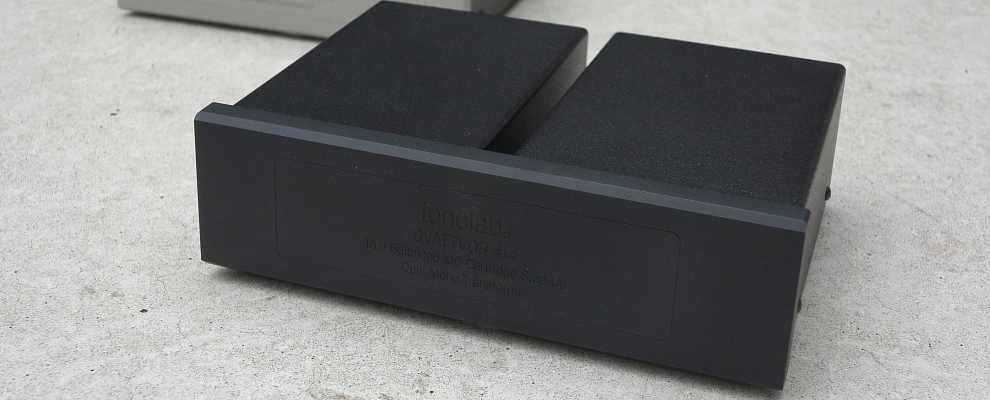
- QVATTVOR 4x4 — reference-level channel separation (fully balanced XLR architecture)
Selection Guidance
Choose Engineering if your priority is:
- structural clarity over continuous flow,
- separation over integration,
- analytical insight into the recording.